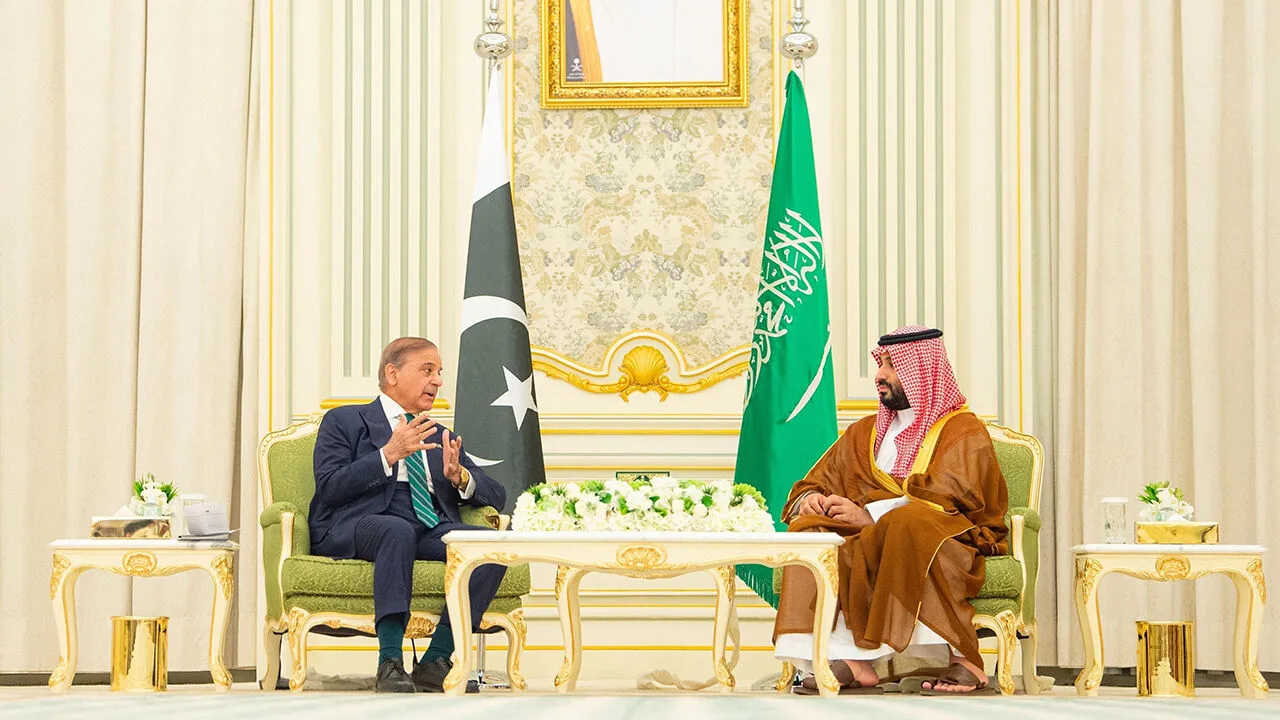

In September 2025, Pakistan and Saudi Arabia took a bold step that has shaken strategic thinking across the Middle East: they announced a defence pact that potentially brings Saudi Arabia under a Pakistani “nuclear umbrella.” This move comes amid rising regional uncertainty, shifting alliances, and the perception that U.S. security guarantees might no longer be enough.
This blog explores what such an umbrella means in practice, how credible it is, how regional actors respond, and whether it marks a new security architecture in the Middle East.
Background: Pakistan’s Nuclear Capabilities
Pakistan is one of the relatively small number of states possessing nuclear weapons. As of 2025, its estimated stockpile is about 170 warheads. Pakistan’s missile reach (e.g., Shaheen series) can hit targets several thousand kilometers away, putting much of the region within reach.
Strategically, Pakistan follows a doctrine known as full-spectrum deterrence (formerly called “minimum credible deterrence”). Under this doctrine, Pakistan does not adopt a no-first-use policy; instead, it retains the option to use “any weapon in its arsenal” to defend itself under existential threat.
Thus, Pakistan’s deterrence posture is built around ambiguity and credible threat, rather than strict transparency. That ambiguity gives it room to maneuver — possibly a feature, not a bug, in its international strategy.
What Is a Nuclear Umbrella?
A nuclear umbrella is a security guarantee: a nuclear-armed state pledges to protect another state (usually non-nuclear) by promising nuclear retaliation in the event of aggression. Historically, the United States has extended such umbrellas to NATO allies, Japan, South Korea, etc. The idea is deterrence by extension — the aggressor is discouraged not just by direct retaliation, but by fear of a broader nuclear conflict.
Such umbrellas carry both psychological and strategic weight. But their credibility depends heavily on the pledged state’s political will, capability, and the aggressor’s risk calculus.
From Doctrine to Diplomacy: Pakistan’s Nuclear Posture
Pakistan’s doctrine is focused primarily on the Indian threat. Its deterrence logic is rooted in historical rivalry with India, not necessarily in projecting power into the Middle East.
Thus, stretching that doctrine into a regional agreement — e.g., offering a shield beyond its borders — represents a shift. Whether that shift is symbolic, conditional, or binding remains a key question. Some analysts suggest that the more Pakistan hints at willingness, the more pressure it invites to prove it in a crisis.
The Saudi-Pakistan Defence Pact (2025)
On 17 September 2025, Pakistan and Saudi Arabia signed what’s called the Strategic Mutual Defense Agreement. Under the pact, any aggression against either nation is considered aggression against both, thereby instituting collective defense.
Importantly, while nuclear weapons are not explicitly mentioned in the publicly released language, analysts see the pact as potentially paving the way to a de facto nuclear umbrella. Pakistan’s Defence Minister has said its capabilities “will be made available” under the agreement, though it has also stated that nuclear deployment is “not on the radar.”
This deliberate ambiguity may be the point — deterrence often relies on uncertainty.
Ambiguities and Denials
While many analysts interpret the pact as implicitly extending Pakistan’s deterrent to Saudi Arabia, Pakistani officials continue to walk back that narrative.
- They emphasize that the pact is about conventional defense cooperation, training, military logistics, and joint deterrence, rather than explicit nuclear guarantees.
- They insist that nuclear weapons, in effect, are not a term of the agreement.
- This dual message — signaling strength, denying overcommitment — is a classic posture in deterrence diplomacy.
Regional Reactions: India, Iran, U.S., Israel
Predictably, India sees this as a challenge to its own regional dominance and will scrutinize whether Pakistan will surrender its policy autonomy or get drawn into Gulf conflicts.
Iran and Israel, both key strategic actors, will watch closely for escalatory signals or shifts in alliance patterns. U.S. policy responses will likely range from recalibration to pressure, given its interests and existing alliances in the region.
Strategic Risks and Costs
There are several dangers:
- Credibility Gap: If Pakistan fails to act in a crisis, the umbrella becomes a hollow promise, damaging its reputation.
- Arms Race: Regional neighbors might respond by boosting their own deterrent capabilities.
- Overextension: Committing to defend external states may stretch resources or entail involvement in conflicts unrelated to core national interests.
- Escalation: A crisis in the Middle East could spiral into wider conflict if nuclear thresholds are approached.
Deterrence vs. Assurance
A nuclear umbrella is useful mainly for deterrence — convincing potential aggressors that attack is too costly. But for the “sheltered” state, what matters more is assurance: belief that protection will actually be delivered in crisis.
If the sheltered state doubts its protector’s will to follow through, the umbrella adds little. Thus, strategic signaling, clear red lines, and political resolve are crucial.
Lessons from Past Umbrellas
History provides mixed lessons:
- The U.S. umbrella over Europe held because of deep institutional ties and high stakes.
- In other settings, umbrellas were doubted or resisted (e.g., doubts about U.S. guarantee during crises in Vietnam or Taiwan).
- Ambiguity can help in peacetime but can doom credibility in crisis.
Scenarios: How It Could Play Out
- Optimistic: Pakistan commits with political and military clarity; deterrence works, the region stabilizes under new security architecture.
- Bleak: A major conflict tests the pact; Pakistan hesitates; Saudi Arabia loses faith; deterrence fails, triggering arms race.
- Mixed: Saudi gets conventional protection; nuclear component stays ambiguous; deterrence works partly; tensions persist.
Conclusion
The question — “Would you shelter under Pakistan’s nuclear umbrella?” — captures the heart of modern deterrence dilemmas. On paper, the idea of Pakistan extending its nuclear shield to Saudi Arabia is dramatic and geopolitically bold. But in practice, the challenges of credibility, escalation risk, resource constraints, and regional reaction make it far from certain.
If you were Saudi, would you rely on this umbrella? Probably only if backed by clear commitments, transparent doctrine, and mutual stakes. Until then, it remains a powerful but speculative shield.
FAQs
1. What does “nuclear umbrella” really mean?
It’s a security guarantee, typically by a nuclear-armed state to a non-nuclear ally, promising nuclear retaliation in case of aggression.
2. Does the Saudi-Pakistan defense pact explicitly include nuclear weapons?
No. The agreement’s public wording does not mention nuclear weapons; it frames collective defense. Analysts, however, see potential for de facto umbrella extension.
3. Is Pakistan’s nuclear doctrine designed for regional protection beyond India?
Historically, Pakistan’s doctrine is India-focused (full-spectrum deterrence). Extending protection to states outside its immediate region is a shift, and its feasibility is uncertain.
4. Can a nuclear umbrella actually deter aggression?
Yes — if it’s credible. But deterrence depends on the aggressor’s belief that the umbrella state will act decisively under attack.
5. What are the main risks of Pakistan offering protection to Saudi?
Key risks include loss of credibility if Pakistan fails to follow through, potential arms race, overextension, and escalation in conflict zones.
6. How have past nuclear umbrellas fared?
They’ve succeeded where backing is firm (e.g., U.S.–NATO). They’ve faltered where ambiguity prevailed or in crises with weak resolve.