
Introduction
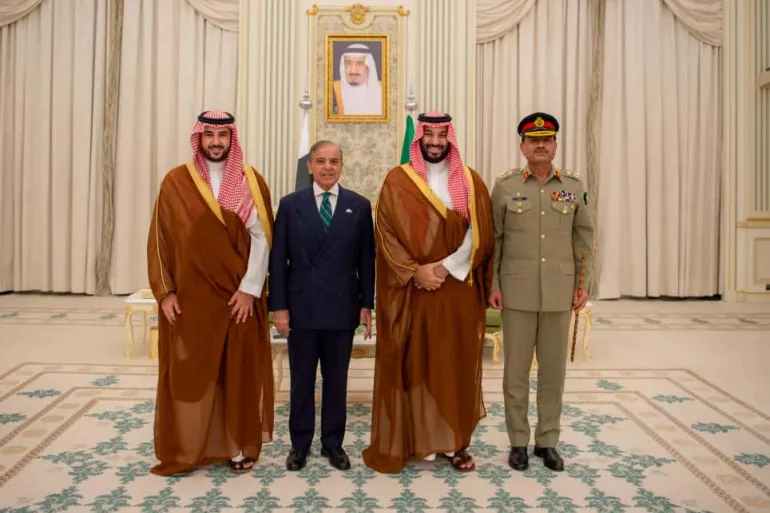
In a landmark move, Saudi Arabia and Pakistan signed a mutual defence pact on September 17, 2025, strengthening their decades-old alliance. The agreement, signed in Riyadh by Crown Prince Mohammed bin Salman and Prime Minister Shehbaz Sharif, comes at a time of heightened regional instability following Israeli strikes on Qatar.
This deal represents not just a bilateral commitment but also a significant shift in the balance of power in the Middle East and South Asia.
What the Pact Entails
The agreement declares that any aggression against either country will be treated as aggression against both. While Saudi officials deny it is a direct response to recent events, the timing suggests otherwise.
Key Features:
- Comprehensive defence cooperation across land, air, and naval forces.
- Strengthening of military training and joint operations.
- Pakistan’s potential role as a nuclear umbrella for Saudi Arabia.
- Expansion of already existing Pakistani troop deployments in Saudi Arabia.
Why Now?
The pact follows years of negotiations but gained urgency after Israel’s controversial strikes in Qatar earlier this month. Gulf states have also grown increasingly wary about the United States’ reliability as a security guarantor.
For Saudi Arabia, the deal cements ties with the only nuclear-armed Muslim-majority nation, while for Pakistan, it reinforces economic and strategic support from one of its closest allies.
Regional Reactions
- India: New Delhi is closely monitoring the pact, given Pakistan’s role in regional rivalries. India’s foreign ministry said it would assess the implications for its own security.
- Israel & Iran: Both countries are likely to view the pact with suspicion, especially since it could counterbalance their influence in the Gulf.
- United States: Washington may see this as another sign of diminishing U.S. sway in the Middle East.
The Broader Context
Saudi Arabia and Pakistan share a relationship rooted in faith, security, and finance. Saudi Arabia has often bailed out Pakistan financially, including a recent $3 billion loan extension. In return, Pakistan has stationed troops in the Kingdom for decades.
With this pact, the relationship is now institutionalized—moving from informal cooperation to a formal security alliance.
Implications for Global Security
This pact could reshape the security dynamics of the Middle East and South Asia:
- It might encourage other Gulf states to seek stronger ties with Pakistan.
- It could push India to deepen defence cooperation with the U.S. and other allies.
- It may lead to a new strategic bloc in the Muslim world, countering Israel and Iran.
FAQs
1. Why is the Saudi-Pakistan defence pact significant?
Because it formally commits two major Muslim powers to defend each other, altering regional security dynamics.
2. Does this pact mean Pakistan will provide nuclear weapons to Saudi Arabia?
Not directly. But Pakistan may extend a nuclear umbrella, providing assurance without transferring weapons.
3. How does India view this pact?
India is cautious and studying the implications, as it could intensify regional rivalries.
4. What role did Israel’s strike on Qatar play?
While Saudi Arabia denies direct links, the timing suggests it accelerated the signing of this agreement.
5. Will this pact affect U.S. influence in the Middle East?
Yes, it signals Gulf states are diversifying their security partners beyond Washington.
6. Could this lead to a new arms race in the region?
Possibly. Israel, Iran, and India may respond with new security measures.
Conclusion
The Saudi-Pakistan mutual defence pact marks a turning point in regional geopolitics. By binding their security interests, both nations have sent a strong signal to allies and rivals alike. Whether this leads to greater stability or deeper rivalries remains to be seen—but one thing is certain: the global balance of power is shifting.