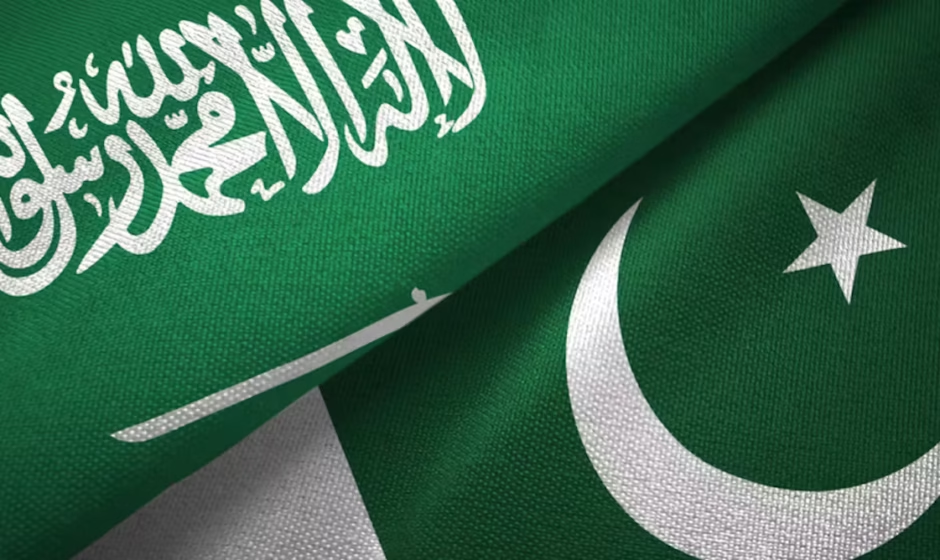

On 17 September 2025, Pakistan and Saudi Arabia signed the Strategic Mutual Defence Agreement (SMDA), under which any aggression against one will be considered an act of aggression against both. This deal formalizes enhanced military cooperation and joint deterrence between Islamabad and Riyadh.
For India, which has historically been wary of Pakistan’s strategic alliances, this pact triggers a number of concerns—some immediate, some longer-term. Below are the main reasons why New Delhi is uneasy.
Key Aspects of the Pact
- The agreement commits Pakistan and Saudi Arabia to a mutual defence clause: aggression against one is aggression against both.
- It aims to deepen defence cooperation, joint deterrence, and possibly shared strategic assets or capabilities.
- While the full text has not been made public in detail, there have been statements suggesting possible nuclear implications or “nuclear umbrella” fears.
Why India Finds this Pact Unsettling
1. Shifting Strategic Balance in the Region
India traditionally views Pakistan as a rival, and defence alignments between Pakistan and a major Gulf power like Saudi Arabia could shift the regional strategic equilibrium. The potential for Saudi Arabia to offer support—military, diplomatic, logistical—changes how India must evaluate threats along its western front, and more broadly in its foreign policy toward the Middle East.
2. Perception of Nuclear Implications
Though there is no public confirmation that Saudi Arabia will be granted any control over Pakistan’s nuclear arsenal, there is concern over “nuclear umbrella”-type assumptions. Saudi Arabia has previously expressed interest in nuclear technology, and Pakistan is one of the few Muslim-majority nuclear powers. Even the suggestion that Pakistan’s “strategic” assets might cover Saudi Arabia adds a layer of anxiety for India.
3. Potential for Escalation
If any conflict involving Pakistan arises, there is the question: would Saudi Arabia’s mutual defence obligations pull Riyadh in? India worries this could escalate border skirmishes, cross‐border operations, or proxy conflict further, making diplomatic and military management more complex.
4. Diplomatic Implications with Saudi Arabia
India has in recent years invested in strong ties with Saudi Arabia—energy imports, trade, investment, geopolitical cooperation. This pact complicates that relationship: New Delhi may perceive a need to ensure that its own interests are not compromised, and that its relations with Riyadh take into account India’s sensitivities.
5. Domestic Political Pressure
In India, the opposition has seized on the pact to question the government’s foreign policy strategy and effectiveness, particularly pointing out that despite India engaging diplomatically with Saudi Arabia, this deal was signed. So beyond the strategic/diplomatic issues, there’s internal political pressure to respond.
6. Signal of Realignment
More broadly, this pact could signal Saudi Arabia trying to diversify its security relationships beyond its traditional dependence on certain powers, especially in response to Middle East regional conflicts and uncertainties in U.S. policy. For India, any shift among major regional players makes its own foreign policy environment more unpredictable.
What India Is Doing / Might Do in Response
- Diplomatic Push: India is emphasizing its strategic partnership with Saudi Arabia, urging Riyadh to consider India’s concerns and “sensitivities.”
- Monitoring the Pact Closely: The Indian government says it will study the agreement’s implications carefully.
- Balancing with Other Alliances: India may deepen alliances in South Asia, with the Gulf, or globally, to offset any shifts. Reinforcing defense posture, surveillance, improving intelligence, or expanding cooperation with other regional players could be part of that.
Risks and Uncertainties
- The exact scope of the defence pact is somewhat vague: it’s not clear how far the mutual defence obligations go, what military infrastructure or nuclear/missile cooperation is included, or whether Saudi bases or joint command structures are involved. That uncertainty itself causes concern, but also limits clarity in responses.
- Escalation risks if misperceptions happen—for example, if India acts on intelligence believing Saudi support to Pakistan is active in a conflict, even if it’s not.
- Possible diplomatic backlash, if India is seen as isolating itself, or if external powers interpret India’s reactions as aggressive.
Conclusion: A New Test for Indian Diplomacy & Strategy
The Saudi-Pakistan defence pact is more than a symbolic gesture—it has the potential to alter regional power equations, especially from India’s viewpoint. While India is not in a military standoff with Saudi Arabia, the defence pact introduces variables India can no longer take for granted:
- Saudi Arabia’s posture and allegiances become more consequential in South Asian security issues.
- India will need to recalibrate its defence strategy, intelligence gathering, and diplomatic outreach.
- There’s increased risk of miscalculation or miscommunication.
For India, the challenge now is twofold: to reassure its strategic partners (including Saudi Arabia) that India’s interests remain respected, while also shoring up its defense and diplomatic architecture to deal with a more complex neighbourhood.
FAQs
Q1: Does this pact mean Saudi Arabia will use Pakistan’s nuclear weapons if needed?
A: There is no definitive proof that Saudi Arabia gains operational control of Pakistan’s nuclear arsenal. Some fears hint at “nuclear umbrella” implications, but nothing is confirmed.
Q2: Is India likely to face direct military pressure from Saudi Arabia now?
A: That seems unlikely in the immediate term. Saudi Arabia’s interests have been mostly regional (Middle East). But indirect forms of pressure—diplomatic, economic, or through proxy support—become more plausible concerns.
Q3: Could this pact provoke India to strengthen ties with other powers (e.g. U.S., Iran, Russia)?
A: Yes. One response is to deepen existing alliances or form new ones, enhance military readiness, increase defence spending, and push for improved intelligence cooperation with friendly states.
Q4: What impact could this have on India-Saudi energy/trade relations?
A: Potentially mixed. India depends heavily on Saudi oil and gas supplies. Any diplomatic fallout might risk trade cooperation, but both sides have incentives to avoid damage to their economic relationship.
Q5: How will neighbouring countries view this?
A: Other regional players—like Iran, Turkey, Gulf states, and major powers like China or the U.S.—will watch closely. It could prompt recalibrations of their own strategies, increase diplomatic competition, or lead to new alignments.
Q6: Can India force a rollback or renegotiation of the pact?
A: Not directly. Pakistan and Saudi Arabia are sovereign states. India’s tools are diplomacy, international pressure, alliance building, and demonstrating that its own strategic interests cannot be ignored.